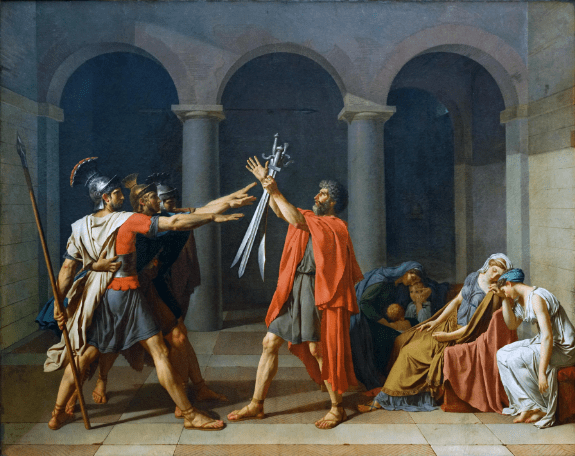
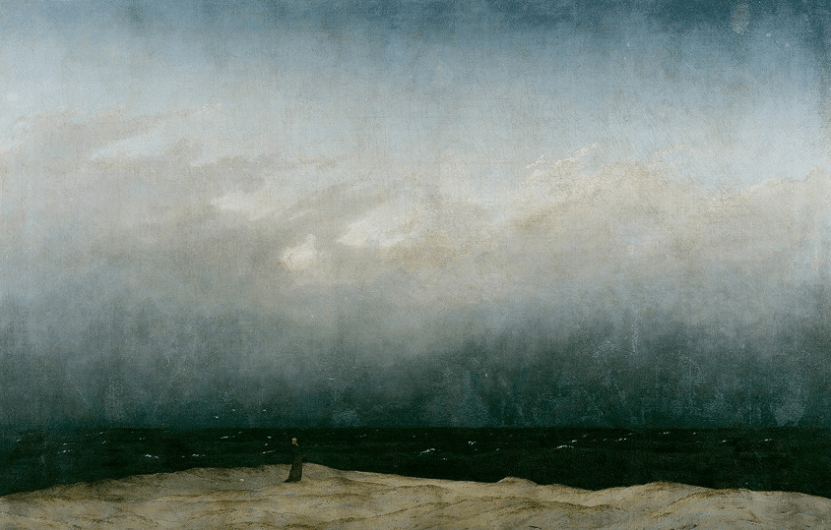
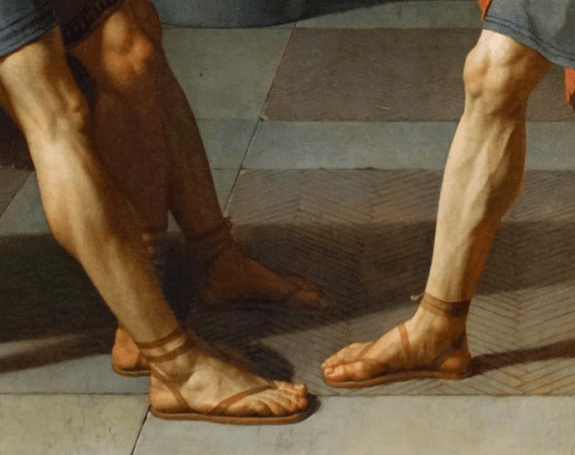
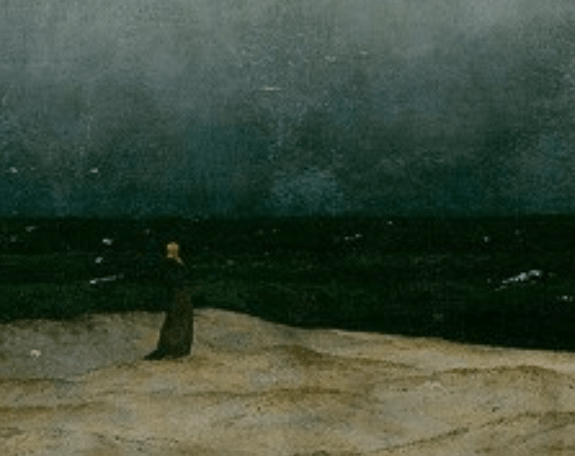
There is no doubt that as we entered into the romantic era of around 1780 to 1830, we were introduced to a fanciful, experimental new wave of art. But how did we get there? Through what means did these new ideas of the romantic come to pass? What concepts did romanticism trainblaizers like David Casper Frierick, Eugene Delacriox and Henry Fuseli try to impart on us and their societies at the time? Romanticism as an artistic movement represented in dreamlike, expressive, worlds rife with true emotion and open to an artist’s imagination. Unlike its counterpart neoclassicalism, romanticism stands less refined, from loser brush strokes to more room for interpretation through art. Oath of Horatii, by Jacques-Louis David, for example, takes a crisp almost photographic form in its composition. Accentuating the power of man down to the details of his muscles. Whereas in this sympathetic,David Casper Friedrich landscape, The Monk By The Sea, we aren’t meant to look at the form of man, rather the form the world takes around man, a more unsettling concept. Neoclassicalism also reinforces learned Renaissance ideas like one point perspective, anatomy, and atmosphere. Romanticism keeps with some of these renaissance ideas like enlightenment in artistic knowledge, but pushes the bounds of realism vs. reality. The borrowing of these ideas allowed for artists in the romantic and neoclassical to depict the same power that came from the renaissance while simultaneously changing the idea of what’s powerful. Having an enlightened understanding of art in their back pockets, romantic artists could create a universe that looked like ours but with their own emotional twist.
One of the most striking pieces to come out of romanticism is undoubtedly Henry Fuseli’s, The Nightmare. Where does one begin to understand the complexity of a work that looks like this? A good place to start is the psyche of the artist himself. Fuseli created this infamous work in 1781 debuting it at The Royal Academy of Exhibitions only a year after. It wasn’t long before the public’s reaction to the painting banned it from being displayed. Clergymen at the time described The Nightmare, as an obscene depiction, never meant for the public eye. Fuseli already had a reputation of being a strange, possibly mentally unwell man. The release of this painting solidified that idea for people in the 18th century. But what society could not accept at the time was that life, in and of itself can be inherently evil. He had a fascination with what lies beneath our subconscious and how we could tap into that. The public were mostly mortified that this sort of picture was born as a strict product of Fuseli’s mind, which of course it was (hence its beauty).
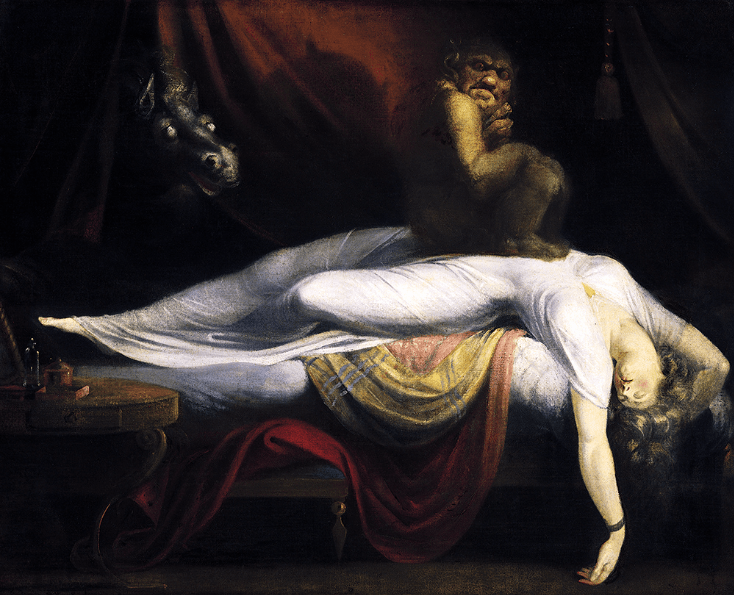
The painting shows a young woman in a bright white dress is sprawled across a bed while an incubus, a type of spirit said to lie on the unsuspecting in their sleep or even to have sexual intercourse with sleeping women. We presume her to be asleep making this scene even more unnerving and suggestive. The dark shadows and bright subject is Fuseli showing us his understanding of chiascuro and how to use it like Caravagio. The work has undeniable techniques borrowed from some of the greats. Fuselis trick is subverting peoples expectations. During the romantic people wanted a dramatically lit drama scene so he gave that to them, the only sacrifice, face your fears while viewing.
A concept honed in the early age of islamic art and orientalism was the ideas of an “other” describing a person society views as an outsider whether that be due to race, religion, socioeconomic status or if you have opposing societal viewpoints. Casting groups of people out and splitting them into factions is a concept long used throughout the world. But what happens when artists are no longer drawing or painting the other like they did but feeling like the other themselves. What happens is brutally honest self exploration through art. Henry Fuseli himself was made into the “other” by his colleagues and consumers. Fuseli started off his career as an “other”. It didn’t take the disapproval of his art to turn him into one. Fuseli like many tragic artists wanted to convey the monsters that lie in our subconscious. We can thank Fuseli for inspiring today’s courageous horror genre artists. His must work encourages artists to depict what they imagine, and to not being afraid of labels society may put on their wellbeing based on their ideas. Directors like Ari Aster, manga artists like Junji Ito can give the world their “sacreligious” and “obscene” art to the world and not be seen as “othered” as Fuseli at his time. The more open we are to entertaining the stories of others the more perspective we may gain on our preconceived “others”.